
Seasonal plex maintenance in Montréal: the spring, summer, fall and winter checklist
Roof, drains, balconies, gutters, heating, water heater, smoke alarms, caulking and snow: a season-by-season checklist for your Montréal plex. Talk to our team.

Owners
Full managementLeasingRent collectionMaintenance and repairsAccountingTAL casesPlex managementMulti-unit buildingsPricingRent increase calculatorApartments
Apartments for rentTenants
Maintenance requestEmergenciesMy leaseDocuments and RL-31Urbanix
AboutBlogContact and quoteFrançaisA landlord must keep the dwelling and its access routes safe for the whole lease, winter included. The TAL lease lets you assign snow clearing of the balcony, entrance or stairs to the tenant, but structural upkeep, the roof and safe exits remain the landlord's responsibility. Here is who does what, and what Montreal and RBQ rules add.
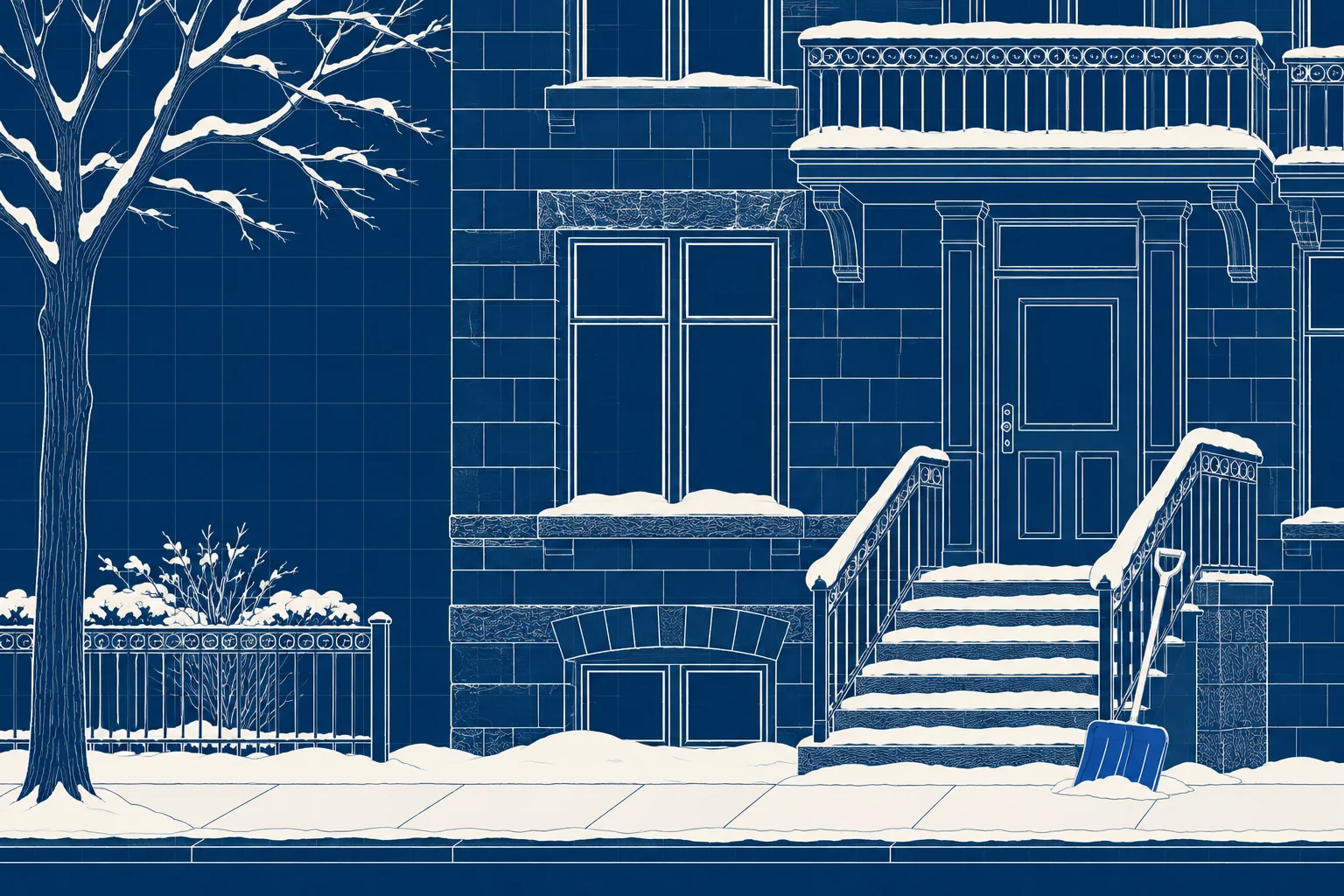
By default, the landlord answers for the safety and habitability of the dwelling for the whole lease (arts. 1854 and 1910 C.C.Q.). The TAL lease form, however, lets you assign snow and ice removal for the balcony, entrance, parking and stairs to the tenant. What the lease says therefore decides who handles the routine work.
The mandatory lease form of the Tribunal administratif du logement includes a section on services, taxes and consumption costs. For each item, you check whether the landlord or the tenant is responsible:
| Item on the TAL lease | Options |
|---|---|
| Snow and ice removal, parking | Landlord or tenant |
| Snow and ice removal, balcony | Landlord or tenant |
| Snow and ice removal, entrance, walkway, driveway | Landlord or tenant |
| Snow and ice removal, stairs | Landlord or tenant |
Three practical rules follow:
The Civil Code requires the landlord to deliver the dwelling in a good state of repair and habitable condition, then keep it that way for the whole lease (arts. 1854 and 1910 C.C.Q.). The landlord must make all necessary repairs, except minor maintenance repairs (art. 1864 C.C.Q.). A dangerous balcony or staircase falls under these duties.
Key articles:
| Article | What it provides | Winter application |
|---|---|---|
| art. 1854 C.C.Q. | Good state of repair and peaceable enjoyment | Usable access to the unit |
| art. 1864 C.C.Q. | Necessary repairs are the landlord’s | Broken steps, loose railing |
| art. 1866 C.C.Q. | Tenant must report a substantial defect | Cracks, sagging, ice build-up |
| art. 1910 C.C.Q. | Good habitable condition for the whole lease | Safe exits |
| art. 1912 C.C.Q. | Breach of a legal safety or maintenance rule gives the same remedies as a breach of the lease | Municipal standards |
| art. 1913 C.C.Q. | A dwelling is unfit if it seriously threatens safety | Extreme cases |
Owners often overlook art. 1912 C.C.Q.: failing to meet the minimum legal requirements for the upkeep and safety of a building (a municipal by-law, for example) gives the tenant the same remedies as a breach of the lease, including a rent reduction or damages (art. 1863 C.C.Q.).
Liability depends on the facts: who had custody of the stairs or balcony, what the lease said, and whether maintenance was reasonable given the weather. The custodian of a thing and the owner of a building that gives way through lack of repair can be required to compensate the injury (arts. 1465 and 1467 C.C.Q.).
For an owner, the useful distinction:
Keep records: snow removal contract, log of visits, photos after storms, notices to tenants. Tell your insurer what the leases say. Check your policy’s specific requirements with your insurance broker.
In Montreal, owners must maintain the building’s exterior elements, including balconies, stairs and the roof, under By-law 23-016 on the occupancy and maintenance of buildings. According to the City, fines range from $1,000 to $40,000. Pushing snow from private property onto public property is also prohibited.
The rules to keep in mind:
On a Montreal plex, the exterior spiral staircase is often the upper unit’s exit. A staircase buried in snow is an exit nobody can use in a fire.
Yes, once the build-up becomes significant. The City of Montreal points out that roofs come under unusual stress during heavy accumulations, especially when rain makes the snow heavier during a thaw. It relays the Régie du bâtiment du Québec’s recommendation to hire specialized companies to protect the roof membrane.
Warning signs the City lists: cracks in walls, doors that stick, unusual creaking, a ceiling that deforms. The City also recommends removing ice and icicles from building ledges, since they can fall on pedestrians and cars.
On a flat plex roof in Montreal, watch for:
The facade inspection and maintenance requirement in the Building chapter of the Safety Code applies to buildings of 5 storeys or more above ground. The owner must obtain a report from an architect or engineer no later than the 10th anniversary of construction, then every 5 years. Most plexes are not covered.
For buildings that are covered, the RBQ requires:
| Requirement | Detail |
|---|---|
| Register | Kept on site: plans, repair work, inspection reports |
| Inspection report | Signed by an architect or engineer, each facade examined within the previous 6 months |
| Dangerous condition | Emergency measures and notice to the RBQ without delay, then a description of corrective work within 30 days |
| Frequency | By the 10th anniversary of construction, then every 5 years |
The RBQ lists signs of balcony deterioration among the clues that call for a closer inspection, and requires anything attached to a facade to be securely fastened. Montreal’s freeze-thaw cycle speeds up exactly this kind of damage.
For a building under 5 storeys, the RBQ does not impose the inspection, but Civil Code and municipal obligations still apply.
Good snow removal is planned in October: leases filled in correctly, contract signed, balconies and stairs inspected before the first snowfall, written instructions to tenants. An owner who documents each step protects the tenants and is better protected against claims.
A simple checklist:
The maintenance and repairs team at Urbanix Gestion Immobilière looks after the buildings we manage, backed by engineers who are members of the Ordre des ingénieurs du Québec. Urbanix also coordinates snow removal for these buildings. Tenants can report a dangerous situation at 514 416 3338.
To review your balconies, stairs and contracts before the first storm, contact our team at 514 416 3338.
This article provides general information. For a specific situation, consult a lawyer or your insurer.
The services section of the TAL lease says whether snow and ice removal for the balcony is the landlord's or the tenant's job. If the lease is silent, the landlord remains bound to keep the dwelling in good habitable condition (art. 1910 C.C.Q.).
Yes, if the lease says so. The TAL lease form has a line for the stairs, the entrance and the balcony. Keeping the stair structure in good repair remains a necessary repair for the landlord (art. 1864 C.C.Q.).
Generally, no. The City of Montreal prohibits pushing, moving or transporting snow or ice onto public property, with limited exceptions in some boroughs. Offenders face fines.
It depends on the facts: who had custody of the stairs, what the lease says and whether maintenance was adequate. The custodian of a thing and the owner of a poorly maintained building can be required to compensate the injury (arts. 1465 and 1467 C.C.Q.).
In most cases, no. Periodic facade inspection under the Building chapter of the Safety Code applies to buildings of 5 storeys or more above ground. A two or three storey plex is still subject to municipal maintenance rules.
Urbanix manages your building from start to finish. Or call 514 416 3338.
Roof, drains, balconies, gutters, heating, water heater, smoke alarms, caulking and snow: a season-by-season checklist for your Montréal plex. Talk to our team.
Notices, showings, move-out inspection, keys, cleaning and a unit in good condition: a Montréal landlord's July 1st timeline. Talk to us about your plex.
Time, TAL risk, vacancy and maintenance: an honest comparison of managing your Montreal plex yourself versus hiring a manager. Let's talk about your building.
Hello. I answer from the pages of this site: services, pricing, areas, apartments for rent, tenants. I have no access to any account or file.
Tenant emergency: 514 416 3338. Urbanix does not keep your questions. Privacy