
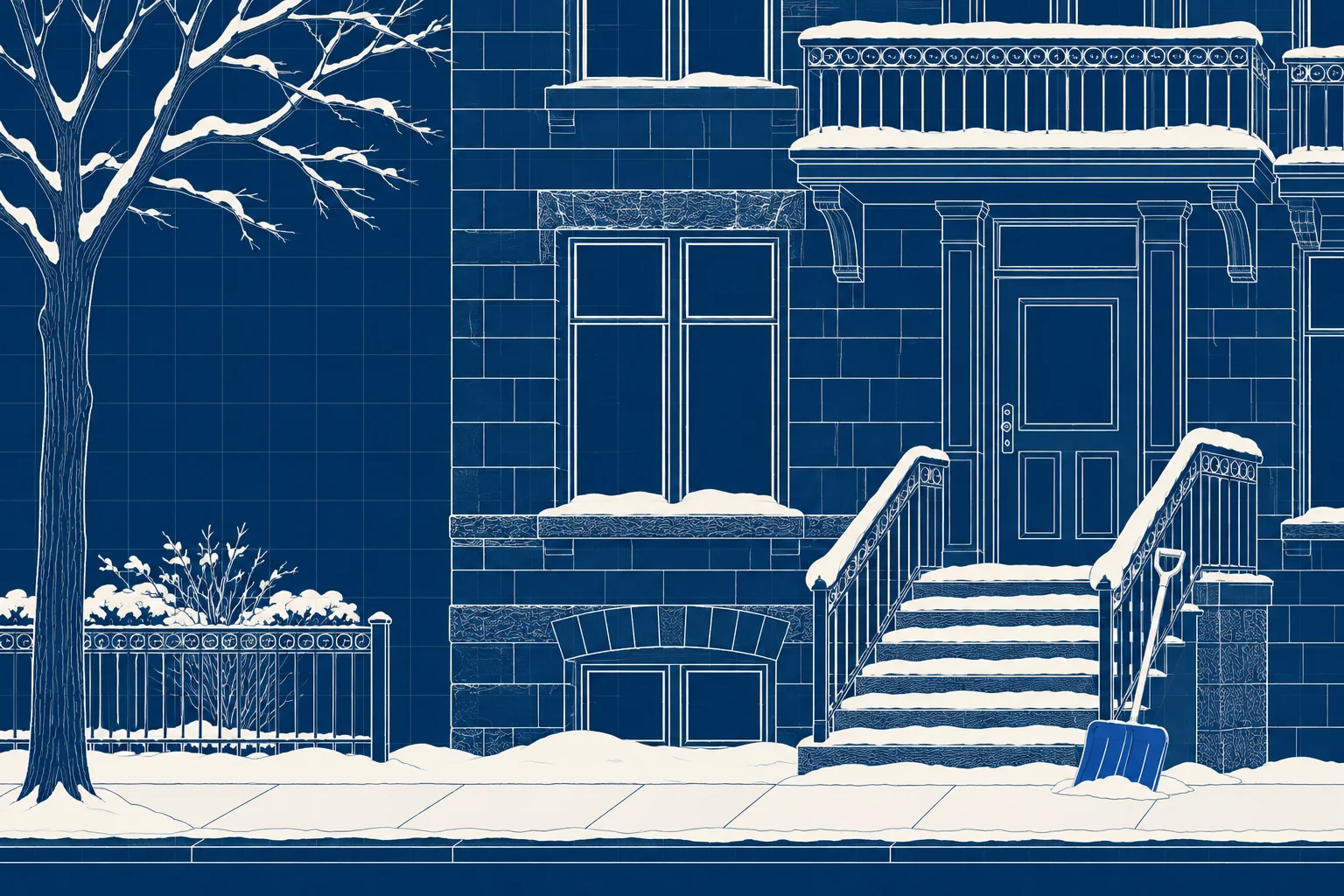
Snow removal on balconies and exterior stairs: the landlord's obligations
Balconies, exterior stairs, roofs: what the Civil Code, the TAL lease, the City of Montreal and the RBQ require of landlords in winter. Talk to our team today.

Owners
Full managementLeasingRent collectionMaintenance and repairsAccountingTAL casesPlex managementMulti-unit buildingsPricingRent increase calculatorApartments
Apartments for rentTenants
Maintenance requestEmergenciesMy leaseDocuments and RL-31Urbanix
AboutBlogContact and quoteFrançaisA Montréal plex is maintained on the climate's schedule: inspect in spring what winter damaged, repair in summer, close up in fall and keep watch in winter. In Montréal, several of these tasks are also regulatory obligations, including heating, smoke alarms, balconies and backwater valves.
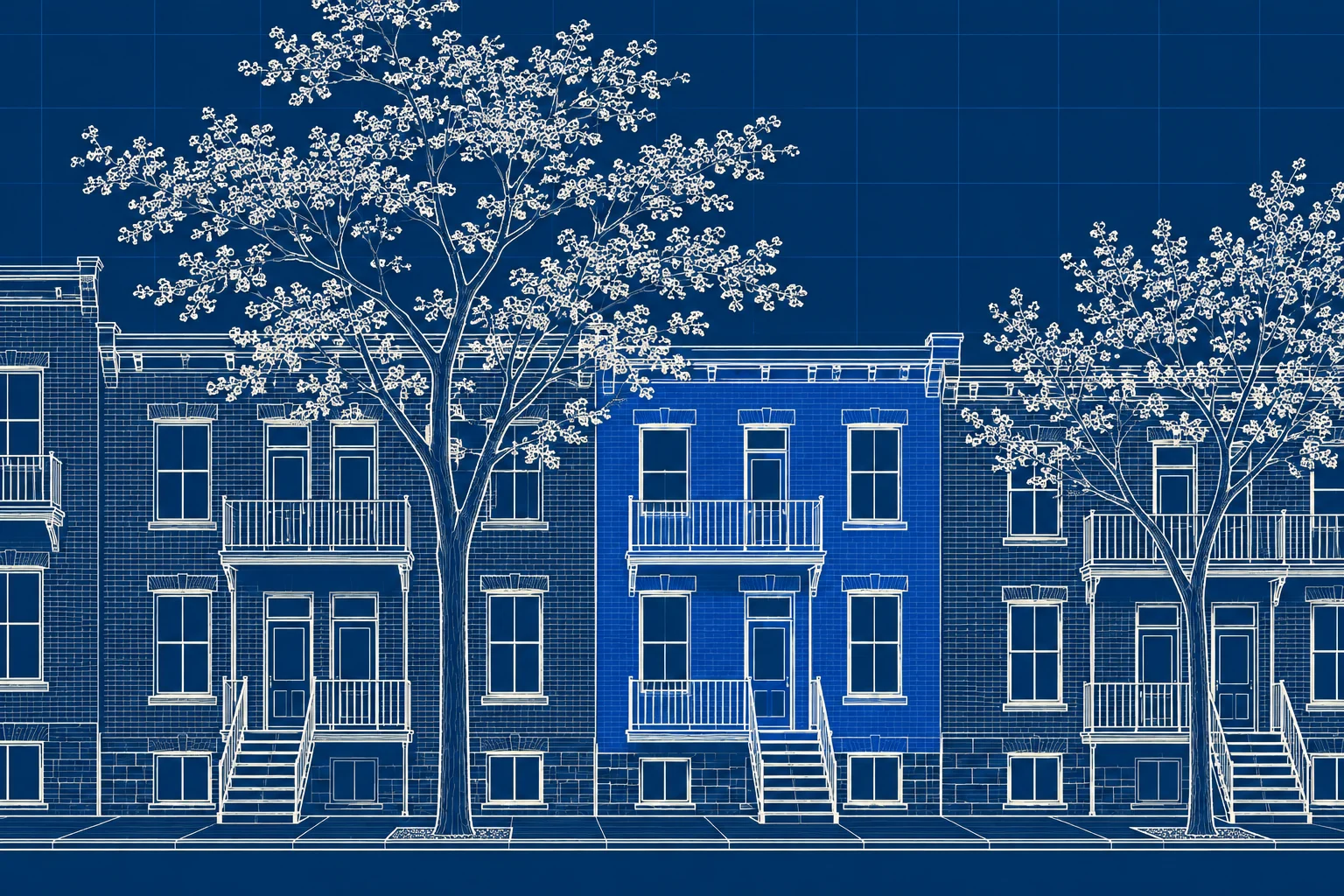
A Montréal plex goes through hot, humid summers, winters below -20 °C, freeze-thaw cycles and freezing rain. Those cycles are what age flat roofs, wooden balconies and window seals. A season-by-season maintenance calendar prevents most emergency repairs and keeps the relationship with tenants on solid ground.
Each season exposes different parts of the building: spring reveals winter damage, summer allows exterior work, fall is for closing the building up, and winter calls for monitoring. A seasonal calendar turns costly emergencies into planned work, done at the right time and at a better price.
The Civil Code sets the framework: the landlord makes all necessary repairs, except minor maintenance repairs that fall to the tenant (art. 1864 C.C.Q.), and keeps the unit in good habitable condition throughout the lease (art. 1910). The tenant must tell the landlord within a reasonable time about any substantial defect or deterioration (art. 1866).
In Montréal, two municipal by-laws add to this:
Spring is for taking stock of winter. As soon as the snow melts, inspect the roof, drains, gutters, balconies and exterior stairs, then the foundation and basement for leaks and cracks. It is also the time to book contractors for summer work, before their schedules fill up.
| Item | What to do | Why |
|---|---|---|
| Flat roof and membrane | Look for blisters, cracks, flashing and seals around vents | Freeze-thaw cycles open up joints |
| Roof drains | Clear leaves and debris, check that water flows | A blocked drain pools water on the membrane |
| Gutters and downspouts | Clean, check brackets, direct water away from the foundation | Keep water away from the base of the wall |
| Balconies and exterior stairs | Check boards, stringers, guards, anchors, rust | Salt and ice speed up deterioration |
| Foundation and basement | Look for cracks, water marks, efflorescence, damp smells | By-law 03-096 prohibits visible mould and requires a dry crawl space |
| Backwater valves | Check they work and are not blocked | Mandatory (by-law 11-010); the City recommends two checks a year |
| Outdoor taps | Turn back on and check for leaks inside the wall | A frozen pipe can split without showing |
| Storm windows | Remove after April 30 if windows are not double-glazed | Required by by-law 03-096 |
Summer is the season for exterior work: roofing, balcony and stair repairs, masonry, painting and caulking. Warm, snow-free weather lets materials cure properly. It is also when most tenants change, which makes it the right time to refresh a vacant unit.
| Item | What to do | Good to know |
|---|---|---|
| Roof repairs | Fix what the spring inspection found | Check whether a borough permit is required |
| Balconies and stairs | Replace damaged boards, stain or seal wood, treat rust | Guards of at least 900 mm on open sides where the drop exceeds 600 mm (03-096) |
| Masonry | Repoint deteriorated mortar joints | Mortar joints are on the by-law 23-016 list |
| Exterior caulking | Redo the seals around windows and doors | Dry, cracked caulking lets in water and air |
| Air conditioners | Check window units are secured and condensation drains properly | A loose unit is a hazard to people below |
| Ventilation | Clean dryer vents and bathroom fans | Prevents moisture problems and fire risk |
| Vacant units | Paint, floors, small repairs | July 1st comes fast: see our July 1st landlord checklist |
For any work inside an occupied unit, give 24 hours’ notice (art. 1931 C.C.Q.). The tenant cannot refuse access for work, except before 7 a.m. or after 7 p.m., unless it is urgent (art. 1933).
Fall is for closing up the building before the freeze. Clean the gutters once the leaves are down, shut off the outdoor taps, have the heating system serviced and check the window caulking. Use the clock change as your reminder to test the smoke alarms in every unit and in the common areas.
| Item | What to do | Why |
|---|---|---|
| Gutters and roof drains | Second cleaning after the leaves fall | Prevents ice dams |
| Outdoor taps | Close the indoor shut-off and drain the line | Prevents frozen pipes |
| Heating system | Service by a technician: furnace, boiler, baseboards, thermostats | By-law 03-096 requires the ability to maintain 21 °C in living spaces |
| Water heater | Check age, leaks, relief valve | Hot water must reach at least 45 °C (03-096) |
| Smoke alarms | Test them, check the manufacture date | Replace ten years after manufacture (RCG 12-003) |
| Carbon monoxide alarms | Check they are present if heating runs on oil, gas or another fuel | The City requires one in that case |
| Windows | Check interior caulking, weatherstripping, hardware | Watertightness required by by-law 03-096 |
| Storm windows | Install by October 30 if windows are not double-glazed | Required by by-law 03-096 |
| Snow removal | Confirm the contract and check that the contractor holds a borough permit | Exits must stay clear all winter |
In Montréal, fire department by-law RCG 12-003 requires the owner to install and maintain smoke alarms: at least one per floor in every unit, basement included. An alarm is replaced ten years after its manufacture date; if there is no readable date, replace it. In buildings built before 1985, alarms must have a non-removable 10-year lithium battery. Owners and tenants share responsibility for checking that alarms work, and the fire department recommends testing them once a month.
Winter is mostly about monitoring: clear exits, no excessive load on the flat roof, working heat and pipes protected from freezing. Regular visits to the common areas and the basement, plus an emergency line tenants can reach, let you act before a water leak or a heating failure gets worse.
| Item | What to do | Why |
|---|---|---|
| Stairs, balconies, walkways, exits | Clear snow and ice promptly | By-law 03-096 requires means of egress to stay clear |
| Flat roof | Watch snow and ice build-up, keep drains open | A frozen drain lets water pool during a thaw |
| Heating | Respond quickly to complaints, check vacant units | 21 °C in living spaces; 15 °C minimum in a vacant unit (03-096) |
| Pipes | Check exterior walls, crawl spaces and garages | Prevents frozen pipes |
| Windows | Watch for condensation and frost inside | A sign of a sealing or ventilation problem |
| Vacant building | Keep it closed, lit and heated to at least 10 °C | Requirements of by-law 23-016 |
Snow on balconies and stairs often raises the question of who is responsible, the landlord or the tenant. Our article on snow removal for balconies and stairs covers the rules.
Most plexes fall outside the five-year façade inspection required by the Régie du bâtiment du Québec (RBQ), which covers buildings with a façade of five storeys or more above ground. The maintenance obligation still applies in full: in Montréal, by-law 23-016 prohibits letting balconies, stairs, roofs and walls deteriorate.
Summary of the verified obligations:
| Obligation | Source | Who |
|---|---|---|
| Façade inspection by an engineer or architect every five years | Building chapter of the Safety Code (RBQ), buildings of five storeys or more | Owner |
| Maintain roof, walls, balconies, stairs, gutters, valve, plumbing, heating | Montréal by-law 23-016 | Owner |
| Heating to 21 °C, hot water at 45 °C, watertightness, no mould | Montréal by-law 03-096 | Owner |
| Smoke alarms on every floor, replaced every ten years | By-law RCG 12-003 | Owner, with checks shared with the tenant |
| Backwater valves in good working order | Montréal by-law 11-010 | Owner |
| Minor maintenance repairs | art. 1864 C.C.Q. | Tenant, except for decay or superior force |
Exact obligations can vary with the year of construction, the borough and the building’s layout. For a specific case, check the current text or consult a professional.
A written calendar, a list of reliable contractors for each trade and a log of work done per building are enough for a duplex. Once you own a few plexes, coordination takes real time: notices to tenants, access, comparing quotes, quality control and tracking expenses for the books.
Urbanix handles building maintenance and repairs in Montréal for owners of plexes and 10 to 50 unit buildings. The company holds an RBQ licence and its team includes engineers who are members of the Ordre des ingénieurs du Québec. Tenants in the buildings we manage reach the emergency line at 514 416 3338. Urbanix inspects the buildings it manages in spring and fall, and aims for same-day response in an emergency.
To build a maintenance calendar for your building, contact the Urbanix team or call 514 416 3338. If you own a plex, see also our page on plex management in Montréal.
Montréal by-law 03-096 requires a permanent heating system able to keep living spaces at 21 °C, except when it is colder than -23 °C outside. A vacant unit must be kept at 15 °C or more.
The owner installs and maintains at least one smoke alarm per floor, basement included, and replaces it ten years after its manufacture date. In buildings built before 1985, alarms must have a non-removable 10-year lithium battery. Tenants share in checking that alarms work.
The RBQ's mandatory periodic inspection covers buildings with at least one façade of five storeys or more above ground, which leaves out most plexes. Montréal by-law 23-016 still requires every owner to maintain balconies, stairs and gutters.
Yes. By-law 11-010 on protecting buildings against sewer backups requires backwater valves and keeping them in good working order. The City recommends checking them ideally twice a year.
Yes. Except in an emergency, the landlord gives 24 hours' notice to check the unit's condition or do work (art. 1931 C.C.Q.). The tenant can refuse access for work before 7 a.m. or after 7 p.m., unless the work is urgent (art. 1933).
Urbanix manages your building from start to finish. Or call 514 416 3338.
Balconies, exterior stairs, roofs: what the Civil Code, the TAL lease, the City of Montreal and the RBQ require of landlords in winter. Talk to our team today.
Notices, showings, move-out inspection, keys, cleaning and a unit in good condition: a Montréal landlord's July 1st timeline. Talk to us about your plex.
Sitting tenants, TAL rent control, building condition, permits, financing and the welcome tax: what to check before you buy a Montreal plex. Talk to us first.
Hello. I answer from the pages of this site: services, pricing, areas, apartments for rent, tenants. I have no access to any account or file.
Tenant emergency: 514 416 3338. Urbanix does not keep your questions. Privacy